
TXA Administration
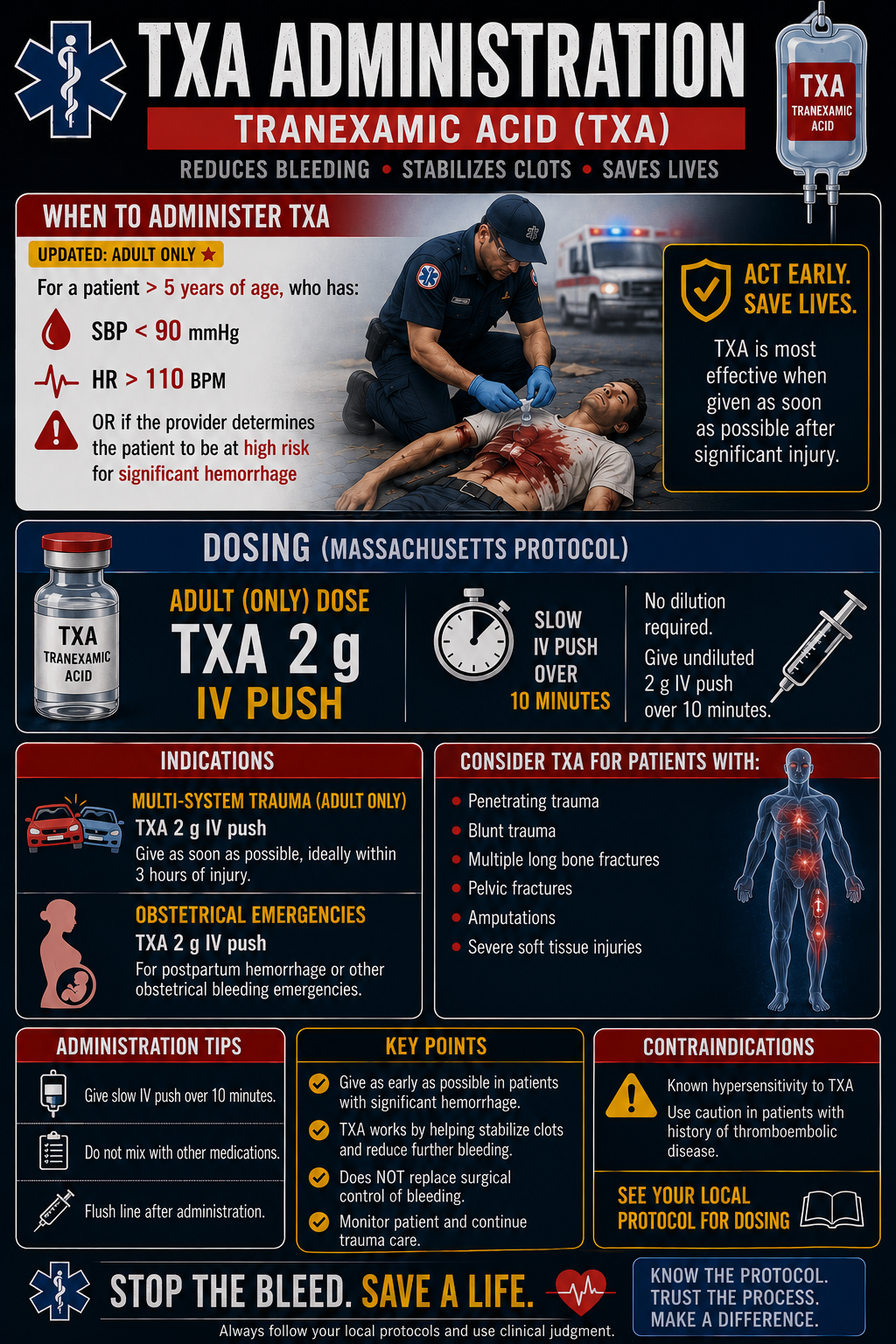
Learn when Tranexamic Acid (TXA) should be administered under the Massachusetts 2026.2 Statewide Treatment Protocols, understand the updated adult dosing recommendations, and recognize patients who may benefit from early hemorrhage control.
Learning Objectives
- • Explain how Tranexamic Acid (TXA) works.
- • Identify patients who meet Massachusetts protocol criteria.
- • Describe the updated 2026.2 adult dosing.
- • Recognize when TXA should be administered.
- • Understand contraindications and precautions.
- • Apply TXA knowledge during trauma scenarios.
What is Tranexamic Acid?
Tranexamic Acid (TXA) is an antifibrinolytic medication that helps preserve existing blood clots. It does not create new clots. Instead, it prevents premature breakdown of fibrin, allowing the body's natural clotting process to stabilize hemorrhage.
Multiple large studies have demonstrated improved survival when TXA is administered early to appropriate trauma patients experiencing significant bleeding.
Massachusetts 2026.2 Adult Protocol
Indications
- ✔ Adult multisystem trauma
- ✔ Suspected significant hemorrhage
- ✔ SBP less than 90 mmHg
- ✔ Heart rate greater than 110 bpm
- ✔ Provider believes patient is at high risk for major bleeding
Adult Dose
2 g
Slow IV Push
Administer over 10 minutes
Obstetrical Emergencies
TXA may also be considered for severe obstetrical hemorrhage when permitted by the Massachusetts statewide protocol and local medical direction. These patients require rapid recognition, aggressive supportive care, and early transport.
Consider TXA When
- ✔ Significant postpartum hemorrhage is suspected
- ✔ The patient has ongoing or uncontrolled bleeding
- ✔ The patient demonstrates signs of hemorrhagic shock
- ✔ Rapid transport and obstetrical notification are underway
Obstetrical Dose
2 g
Slow IV Push
Administer according to current protocol and medical direction
Important
TXA does not replace uterine massage, hemorrhage control, resuscitation, rapid transport, or consultation with medical control.
Administration and Monitoring
Before Administration
- • Confirm the patient meets protocol criteria.
- • Verify the medication, concentration, and expiration date.
- • Confirm IV or IO access is functioning properly.
- • Assess for contraindications and precautions.
- • Obtain and document baseline vital signs.
During Administration
- • Administer the medication slowly as directed.
- • Continuously monitor blood pressure and heart rate.
- • Observe for adverse reactions.
- • Continue hemorrhage-control measures.
- • Reassess the patient frequently.
Avoid Rapid Administration
Rapid administration of TXA may contribute to hypotension. Follow the administration rate required by the current protocol, manufacturer guidance, and medical direction.
Contraindications and Precautions
Do Not Administer
- • Known hypersensitivity to tranexamic acid
- • Patients who do not meet protocol criteria
- • Isolated minor trauma without significant bleeding risk
- • Situations specifically excluded by local protocol
Use Caution
- • Known history of thromboembolic disease
- • Suspected active intravascular clotting
- • Significant renal impairment
- • Uncertainty regarding the cause of bleeding
Clinical Pearls
TXA Preserves Existing Clots
TXA does not directly stop bleeding and does not replace direct pressure, tourniquets, wound packing, pelvic stabilization, or surgical hemorrhage control.
Early Recognition Matters
Look beyond a single blood-pressure reading. Consider mechanism, mental status, skin signs, heart rate, shock index, and suspected internal bleeding.
Do Not Delay Transport
TXA should be administered while definitive transport and trauma or obstetrical-center notification continue.
Document Thoroughly
Document the indication, dose, route, administration time, patient response, reassessment findings, and medical-control contact when applicable.
Knowledge Check
A 42-year-old adult is involved in a high-speed motor-vehicle crash. The patient is pale and diaphoretic, has a heart rate of 126 beats per minute, a systolic blood pressure of 84 mmHg, and suspected internal bleeding.
Does this patient meet the general criteria for TXA consideration?
Yes. This patient has multisystem trauma, hypotension, tachycardia, and a high risk for significant hemorrhage. The provider should continue hemorrhage control, resuscitation, rapid transport, and administer TXA according to the current Massachusetts protocol and local authorization.
Key Takeaways
- • TXA helps prevent the premature breakdown of existing clots.
- • Adult multisystem-trauma dosing is 2 g slow IV push.
- • Obstetrical hemorrhage dosing is 2 g slow IV push.
- • TXA should never delay transport or definitive hemorrhage control.
- • Monitor the patient closely and document all reassessments.
- • Always follow current statewide and local protocols.
Course Complete
Ready to Test Your Knowledge?
Complete the TXA Administration quiz and earn a printable course certificate after achieving the required passing score.