Recognize & Stabilize
Complete routine patient care, identify immediate airway or breathing threats, obtain glucose, and perform a focused neurologic examination.
Massachusetts EMS Clinical Course
Protocol-focused education covering Last Known Well, FAST-ED, stroke mimics, Stroke Alert communication, oxygen use, destination considerations, and documentation.
Protocol
Massachusetts 2.18
Version
2026.2
Assessment
25 Questions • 80%
Section 01
By the end of this course, the learner should be able to:
Section 02
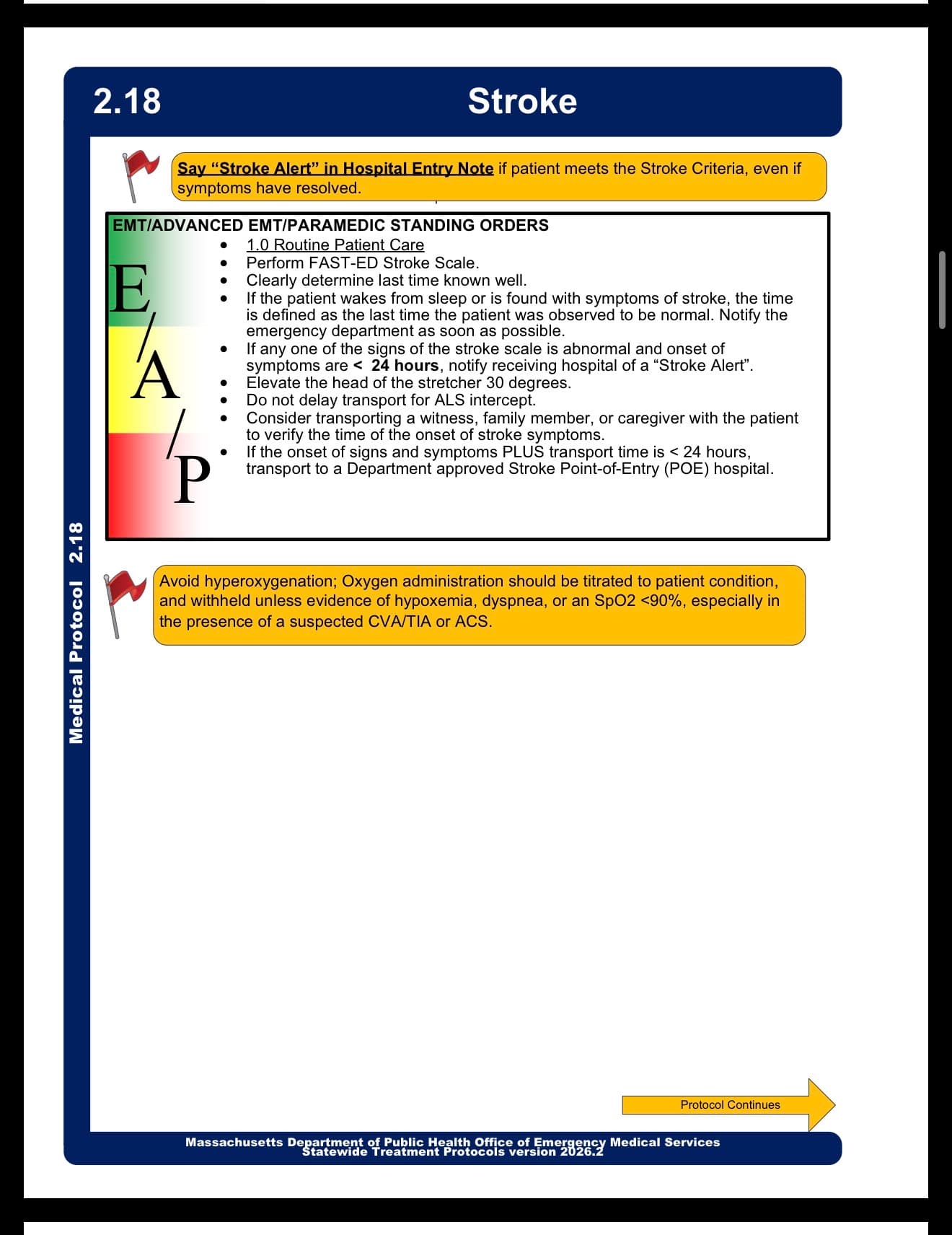
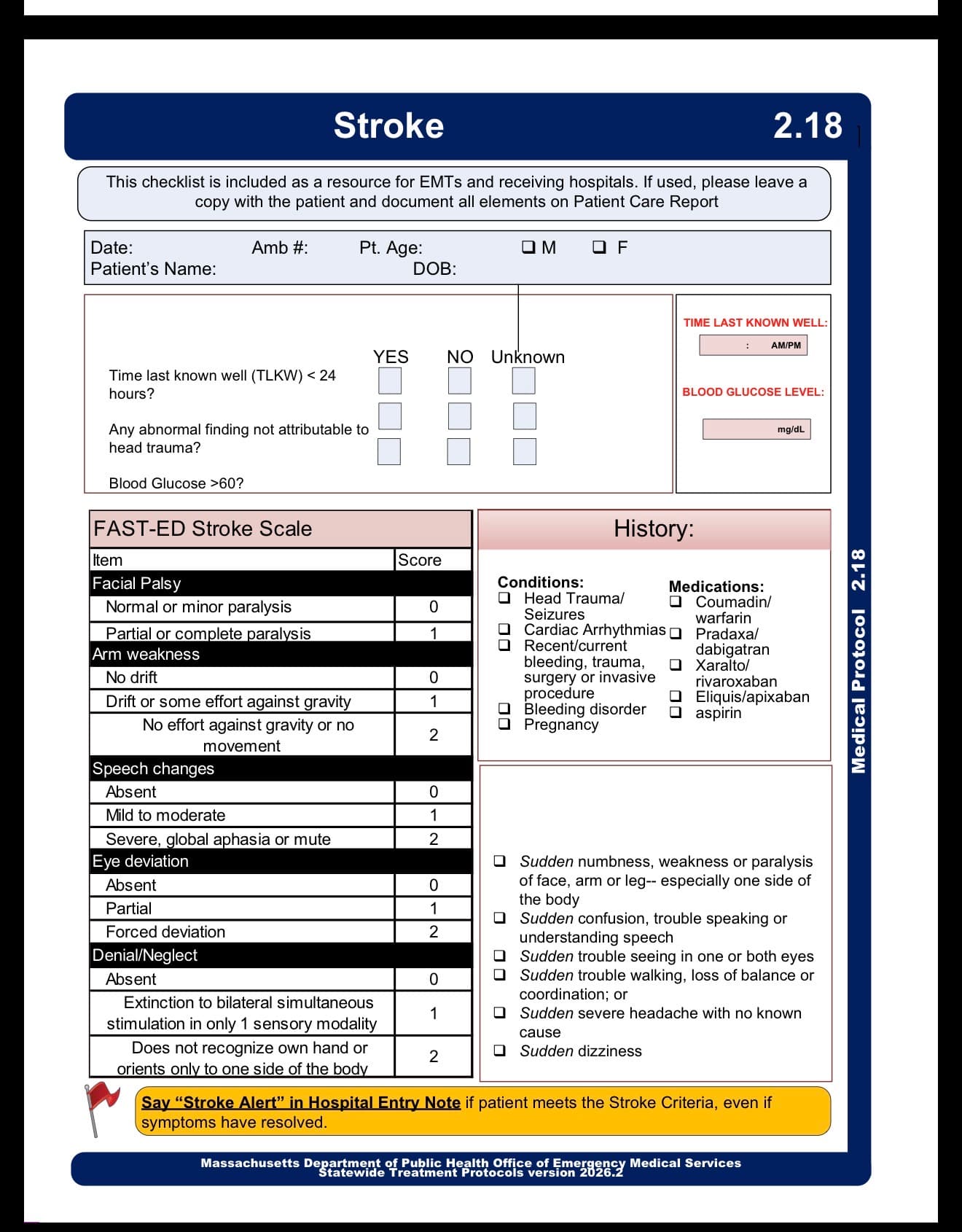
Review the supplied 2026.2 protocol and checklist before continuing.
Section 03
EMS does not determine the stroke subtype in the field.
Complete routine patient care, identify immediate airway or breathing threats, obtain glucose, and perform a focused neurologic examination.
Establish the timeline, call the Stroke Alert early, choose the appropriate destination, and avoid unnecessary scene delay.
Section 04
Prehospital findings may suggest stroke but cannot reliably distinguish ischemia from hemorrhage.
An artery is obstructed by thrombus or embolus, reducing blood flow to brain tissue.
Bleeding occurs within or around the brain and may produce headache, vomiting, hypertension, or rapid deterioration.
Resolved focal deficits remain clinically important and require urgent evaluation.
Section 05
The timeline is one of the most important pieces of information EMS provides.
Last Known Well is the last time the patient was observed at their neurologic baseline—not the time symptoms were discovered.
For symptoms found on awakening, obtain the last time the patient was seen or heard normal before sleep and separately document discovery time.
Section 06
Several conditions can produce focal or stroke-like neurologic findings.
Section 07
Score each domain separately and report both the total and the individual abnormal findings.
Ask the patient to smile or show their teeth. Compare both sides at rest and with movement.
Score
0–1
Have the patient hold both arms out. Score drift, effort against gravity, or no movement.
Score
0–2
Assess naming, repetition, comprehension, aphasia, muteness, and dysarthria.
Score
0–2
Observe resting gaze and the patient’s ability to track without forcing the head or eyes.
Score
0–2
Test simultaneous stimulation and awareness of both sides of the body and environment.
Score
0–2
Section 08
Not every stroke presents with facial droop, arm weakness, or aphasia.
Section 09
Apply the supplied Massachusetts protocol and local implementation.
If any stroke-scale sign is abnormal and onset is less than 24 hours, notify the receiving hospital of a Stroke Alert, even when symptoms have resolved.
Do not delay transport for ALS intercept. Consider bringing a witness or caregiver who can verify symptom onset and baseline.
Avoid routine hyperoxygenation. Titrate to the patient’s condition and use oxygen for hypoxemia, dyspnea, or SpO₂ below 90% as directed by the supplied protocol.
Elevate the head of the stretcher approximately 30 degrees when tolerated while protecting the airway and reassessing frequently.
Section 10
Early, complete communication helps the receiving stroke team prepare.
Example Radio Report
“Hospital, Medic 24 with a Stroke Alert. Seventy-two-year-old male, LKW 1410, sudden aphasia and right arm weakness. FAST-ED 5, glucose 112, takes apixaban, BP 188/96, SpO₂ 95% room air. ETA eight minutes.”
Section 11
Pause before revealing the discussion points.
A 68-year-old is found aphasic at 0630. The spouse last spoke with the patient normally at 2230.
The patient had 15 minutes of unilateral weakness and slurred speech that resolved before EMS arrival.
The patient has facial droop and confusion with a glucose of 42 mg/dL.
The patient has sudden vomiting, diplopia, and cannot stand, but has no arm drift.
Section 12
The PCR should preserve the timeline and the neurologic examination.
Course Review Complete
The quiz contains 25 questions. A score of 80% or higher unlocks the completion certificate.
Begin Quiz