
← Back to Courses

Massachusetts EMS Clinical Course

Adult & Pediatric Sepsis

Recognition of possible septic shock, protocol-directed care, fluid therapy, reassessment, Medical Control options, and hospital notification.

Protocols

2.17A & 2.17P

Version

Massachusetts 2026.2

Assessment

25 Questions • 80%

Section 01

Learning Objectives

By the end of this course, the learner should be able to:

Recognize possible adult and pediatric septic shock.
Differentiate adult and pediatric sepsis criteria.
Apply EMT, Advanced EMT, Paramedic, and Medical Control guidance.
Calculate pediatric fluid boluses and age-based minimum systolic pressure.
Reassess perfusion and identify signs of fluid overload.
Deliver an organized Sepsis Alert and document treatment response.

Section 02

GrumpyMedic Protocol Reference

Review the adult and pediatric Massachusetts sepsis protocols before continuing.
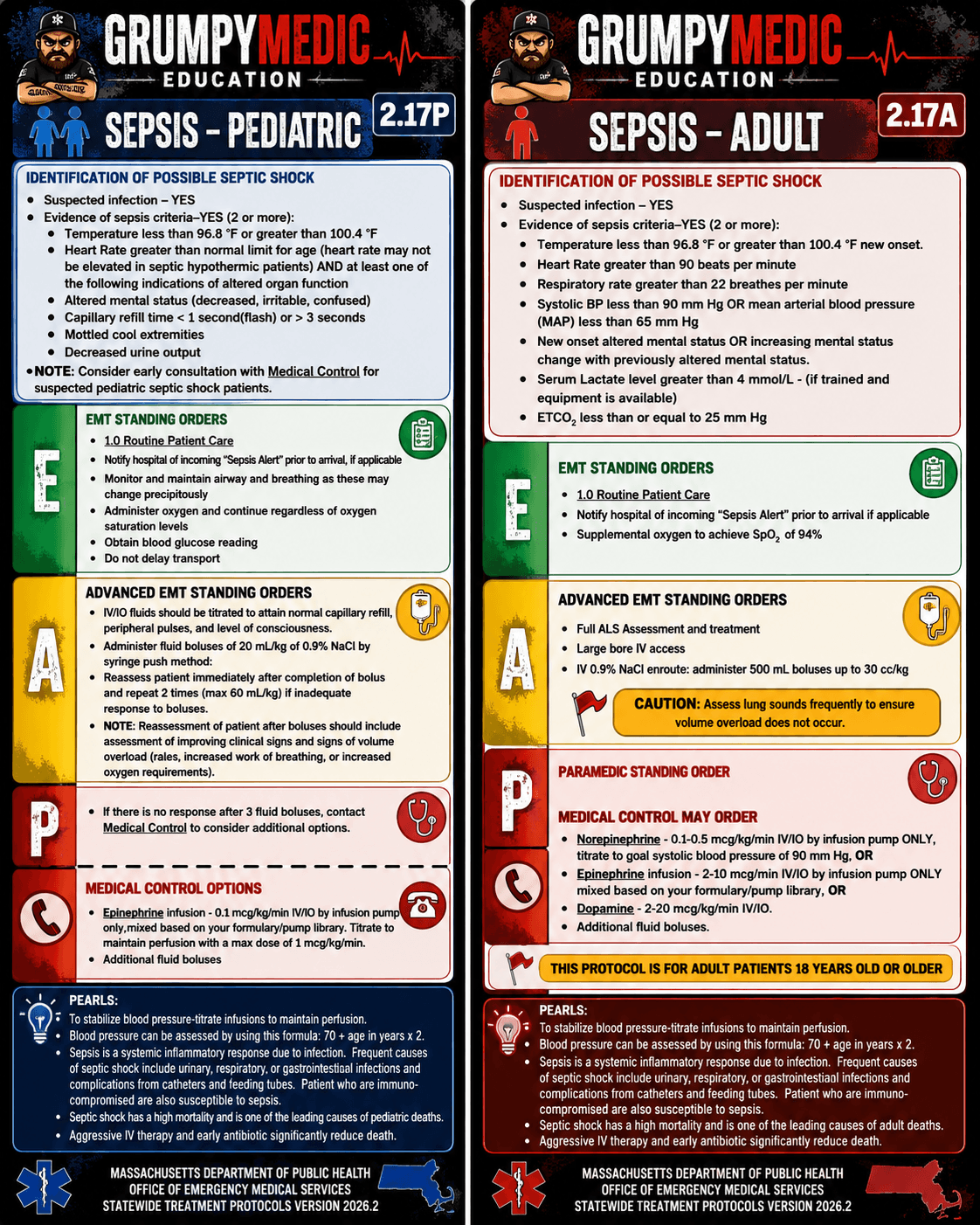
GrumpyMedic adult and pediatric sepsis protocol reference

Protocol Reminder

Always verify current Massachusetts statewide protocols, addenda, service policy, local Medical Control requirements, and your authorized scope of practice before clinical use.

Section 03

What Is Sepsis?

Sepsis is a systemic response to infection that can progress to organ dysfunction and shock.

Suspected Infection

The protocol begins with concern for an infectious source, including respiratory, urinary, gastrointestinal, catheter, feeding-tube, or other infections.

Organ Dysfunction

Altered mental status, abnormal perfusion, hypotension, abnormal respiratory findings, and reduced urine output may indicate worsening organ function.

Septic Shock

Septic shock requires rapid recognition, transport, circulatory support, frequent reassessment, and early hospital notification.

Section 04

Adult Identification

Protocol 2.17A applies to adult patients 18 years of age or older.

  • Suspected infection.
  • Two or more sepsis criteria.
  • Temperature below 96.8 °F or above 100.4 °F with new onset.
  • Heart rate greater than 90 beats/minute.
  • Respiratory rate greater than 22 breaths/minute.
  • Systolic pressure below 90 mm Hg or MAP below 65 mm Hg.
  • New or worsening altered mental status.
  • Serum lactate above 4 mmol/L when available.
  • ETCO₂ at or below 25 mm Hg.

Adult Thresholds

Adult septic shock criteria include systolic blood pressure below 90 mm Hg or MAP below 65 mm Hg. ETCO₂ at or below 25 mm Hg and lactate above 4 mmol/L may also support concern when available.

Section 05

Pediatric Identification

Pediatric assessment depends heavily on age-appropriate findings and perfusion.

  • Suspected infection.
  • Two or more pediatric sepsis criteria.
  • Temperature below 96.8 °F or above 100.4 °F.
  • Heart rate above the normal range for age.
  • Altered mental status: decreased, irritable, or confused.
  • Capillary refill below 1 second or above 3 seconds.
  • Mottled, cool extremities.
  • Decreased urine output.

Pediatric Blood Pressure Pearl

Minimum systolic pressure ≈ 70 + (age in years × 2)

Use the formula as a screening reference while evaluating the whole child, including mental status, capillary refill, peripheral pulses, skin findings, and urine output.

Section 06

Adult Standing Orders

Apply the adult protocol while reassessing for response and volume overload.

  • Routine patient care.
  • Notify the hospital of an incoming Sepsis Alert when applicable.
  • Supplemental oxygen to achieve SpO₂ of 94%.
  • Full ALS assessment and treatment.
  • Establish large-bore IV access.
  • Administer 0.9% NaCl in 500 mL boluses up to 30 mL/kg.
  • Assess lung sounds frequently for volume overload.

Medical Control May Order

  • • Norepinephrine infusion: 0.1–0.5 mcg/kg/min.
  • • Epinephrine infusion: 2–10 mcg/min.
  • • Dopamine infusion: 2–20 mcg/kg/min.
  • • Additional fluid boluses.

Adult Reassessment

  • • Blood pressure and mental status.
  • • Peripheral perfusion and urine output.
  • • Lung sounds and work of breathing.
  • • Oxygen requirement and signs of overload.

Section 07

Pediatric Standing Orders

Fluid therapy is weight based and requires immediate reassessment after every bolus.

  • Routine patient care.
  • Notify the hospital of an incoming Sepsis Alert when applicable.
  • Monitor and maintain airway and breathing.
  • Administer oxygen and continue regardless of oxygen saturation.
  • Obtain a blood glucose reading.
  • Do not delay transport.
  • Administer 20 mL/kg 0.9% NaCl boluses by syringe push.
  • Reassess immediately after each bolus and repeat up to two additional times.

Maximum Initial Bolus Strategy

Repeat 20 mL/kg boluses up to two additional times when the response remains inadequate, for a maximum initial total of 60 mL/kg.

Medical Control Options

  • • Epinephrine infusion: 0.1 mcg/kg/min, titrated to perfusion, maximum 1 mcg/kg/min.
  • • Additional fluid boluses.

Contact Medical Control

If there is no response after three pediatric fluid boluses, contact Medical Control for additional options.

Section 08

Fluid Therapy & Reassessment

Fluids are a treatment trial, not a set-and-forget intervention.

Signs of Improving Perfusion

  • Improving mental status
  • Stronger peripheral pulses
  • Normalizing capillary refill
  • Improving blood pressure
  • Improved skin temperature and color
  • Improved urine output

Signs of Volume Overload

  • New rales
  • Increasing work of breathing
  • Increasing oxygen requirement
  • Worsening respiratory distress
  • Deterioration after a bolus

Section 09

Sepsis Alert & Hospital Notification

Early notification helps the receiving hospital prepare for rapid evaluation and treatment.

  • State “Sepsis Alert” when applicable.
  • Provide age and estimated weight.
  • Report suspected infectious source.
  • Provide adult or pediatric criteria met.
  • Report glucose, temperature, blood pressure, and mental status.
  • Report IV access, fluid volume, and response.
  • Report oxygen therapy and respiratory status.
  • Provide ETA and Medical Control orders.

Example Adult Sepsis Alert

“Hospital, Medic 24 with a Sepsis Alert. Seventy-year-old patient with suspected pneumonia, temperature 102.1, heart rate 118, respiratory rate 28, systolic pressure 84, altered mental status, and ETCO₂ 23. Large-bore IV established; 500 mL normal saline given with repeat pressure pending. ETA twelve minutes.”

Section 10

Clinical Scenarios

Pause before opening each discussion.

Case: Adult Pneumonia

A 72-year-old with fever, productive cough, HR 122, RR 30, BP 86/48, ETCO₂ 24, and confusion.

Discussion: The patient has suspected infection and multiple adult sepsis criteria. Initiate a Sepsis Alert, provide protocol-directed oxygen, establish large-bore IV access, begin fluid therapy, and reassess lung sounds and perfusion.
Case: Pediatric Perfusion Failure

A 6-year-old with fever, irritability, mottled cool extremities, capillary refill of 5 seconds, and decreased urine output.

Discussion: This presentation supports possible pediatric septic shock. Maintain airway and breathing, administer oxygen, obtain glucose, begin 20 mL/kg fluid therapy, reassess immediately, and do not delay transport.
Case: Fluid Overload Concern

After an adult receives fluid, rales develop and the oxygen requirement increases.

Discussion: Stop and reassess. These findings suggest volume overload. Report the change, support oxygenation and ventilation, and contact Medical Control as indicated.
Case: Poor Pediatric Response

A child remains poorly perfused after three 20 mL/kg boluses.

Discussion: Contact Medical Control for additional options, including an epinephrine infusion and possible additional fluids, while continuing transport and reassessment.

Section 11

Documentation

Document the criteria, interventions, and the patient’s response.

  • Suspected source of infection
  • Adult or pediatric sepsis criteria
  • Mental status and perfusion findings
  • Blood glucose and temperature
  • Blood pressure, MAP when available, and ETCO₂
  • IV/IO access and total fluid volume
  • Reassessment after every bolus
  • Signs of improvement or overload
  • Sepsis Alert and Medical Control communications

Section 12

Key Takeaways

Review these points before the final quiz.

Sepsis begins with suspected infection plus concerning systemic findings.
Adult and pediatric criteria are not interchangeable.
Pediatric fluid therapy is weight based.
Adult fluid is given in 500 mL boluses up to 30 mL/kg.
Reassess perfusion and respiratory status after every bolus.
Recognize volume overload early.
Call the Sepsis Alert before arrival when applicable.
Do not delay transport.

Course Review Complete

Ready for the final assessment?

The quiz contains 25 questions. A score of 80% or higher unlocks the completion certificate.

Begin Quiz