
GrumpyMedic Education
Obstetrical Emergencies
Massachusetts EMS Protocol 2.10 review covering obstetrical assessment, prolapsed cord, postpartum hemorrhage, eclamptic seizures, medication administration, and maternal cardiac-arrest considerations.
Learning Objectives
By the end of this course, the learner should be able to:
Massachusetts Protocol 2.10 Quick Reference
Review the GrumpyMedic protocol image before continuing.
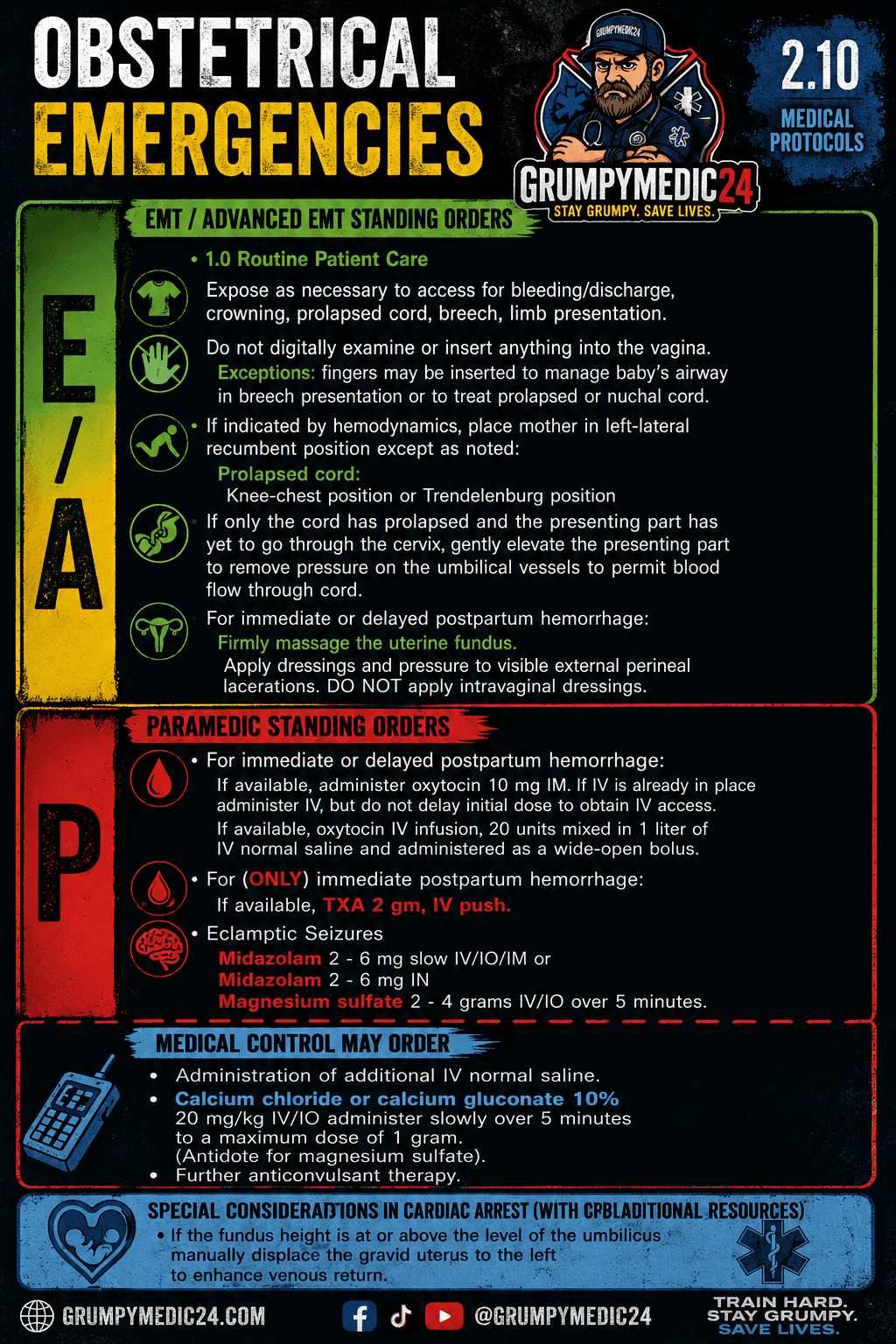
Protocol Reference
This course reviews Massachusetts Statewide Treatment Protocol 2.10. Providers must continue to follow current statewide protocols, local service policies, medical direction, and their authorized scope of practice.
Initial Assessment and Positioning
Identify the emergency while protecting maternal and fetal circulation.
Expose as Necessary
Assess for bleeding or discharge, crowning, prolapsed cord, breech presentation, and limb presentation.
Avoid Digital Examination
Do not digitally examine or insert anything into the vagina except when managing the baby’s airway during breech presentation or treating a prolapsed or nuchal cord.
Left-Lateral Position
When indicated by hemodynamics, place the mother in the left-lateral recumbent position unless a specific obstetrical emergency requires another position.
Prolapsed Cord
Relieve pressure on the umbilical cord and prepare for rapid transport.
Patient Positioning
Place the patient in the knee-chest or Trendelenburg position.
Manual Intervention
If only the cord has prolapsed and the presenting part has not passed through the cervix, gently elevate the presenting part to relieve pressure on the umbilical vessels.
Important
Do not attempt to push the prolapsed cord back into the vagina. Maintain pressure relief, monitor the patient, and prepare for rapid transport.
Postpartum Hemorrhage
Control visible external bleeding and support uterine contraction.
EMT / AEMT Standing Orders
- • Firmly massage the uterine fundus.
- • Apply dressings and direct pressure to visible external perineal lacerations.
- • Do not apply intravaginal dressings.
- • Continue routine patient care, reassessment, and rapid transport.
Paramedic Standing Orders
- • If available, administer oxytocin 10 units IM.
- • If IV access is already in place, oxytocin may be administered IV. Do not delay the initial dose solely to obtain IV access.
- • If available, mix oxytocin 20 units in 1 liter of normal saline and administer it as a wide-open bolus.
- • For immediate postpartum hemorrhage only, if available, administer TXA 2 grams IV push.
Eclamptic Seizures
Treat seizures while supporting airway, ventilation, circulation, and transport.
Midazolam
2–6 mg
Slow IV, IO, or IM
Midazolam
2–6 mg
Intranasal
Magnesium Sulfate
2–4 grams
IV or IO over 5 minutes
Medical Control May Order
- • Administration of additional IV normal saline.
- • Calcium chloride or calcium gluconate 10%, 20 mg/kg IV or IO administered slowly over 5 minutes, to a maximum dose of 1 gram.
- • Calcium is used as an antidote for magnesium sulfate.
- • Further anticonvulsant therapy.
Cardiac Arrest in Pregnancy
Reduce aortocaval compression during maternal resuscitation.
Special Consideration
Manually Displace the Gravid Uterus to the Left
If the fundal height is at or above the level of the umbilicus, manually displace the gravid uterus toward the patient’s left side to improve venous return while resuscitation continues.
Clinical Scenario
Apply the protocol to a time-critical postpartum patient.
You respond to a 30-year-old patient who delivered approximately 15 minutes ago. She is pale and diaphoretic with heavy vaginal bleeding. Her blood pressure is 82/46 and her pulse is 128.
Immediate treatment priorities
- • Begin routine patient care and recognize hemorrhagic shock.
- • Firmly massage the uterine fundus.
- • Apply dressings and pressure to visible external perineal bleeding.
- • Do not place dressings inside the vagina.
- • Support oxygenation, establish vascular access when appropriate, reassess frequently, and begin rapid transport.
- • At the paramedic level, administer oxytocin when available and authorized.
- • For immediate postpartum hemorrhage, administer TXA 2 grams IV push when available and authorized.
Key Takeaways
Review the most important protocol points before taking the quiz.
Final Knowledge Check
Ready to Take the Quiz?
Answer all 20 questions. A score of 80% or higher is required to pass and unlock the completion certificate.
Start Final QuizEducational content only. Follow current Massachusetts statewide protocols, local service policies, medical-control direction, medication instructions, and your authorized scope of practice.