
← Back to Courses

Massachusetts EMS Trauma Course

Multisystem Trauma

Adult and pediatric trauma assessment, catastrophic hemorrhage control, pelvic stabilization, vascular access, airway considerations, TXA, transport, reassessment, and documentation.

Protocol

Massachusetts 4.5

Version

2026.2

Assessment

25 Questions • 80%

Section 01

Learning Objectives

By the end of this course, the learner should be able to:

Recognize immediate life threats in adult and pediatric multisystem trauma.
Apply XABC priorities and control catastrophic hemorrhage.
Use tourniquets, wound packing, and pelvic stabilization appropriately.
Apply provider-level standing orders from Massachusetts Protocol 4.5.
Recognize age-specific TXA indications, dosing, contraindications, and cautions.
Prioritize transport, reassessment, trauma notification, and documentation.

Section 02

GrumpyMedic Protocol Reference

Review the supplied Massachusetts Protocol 4.5 reference.
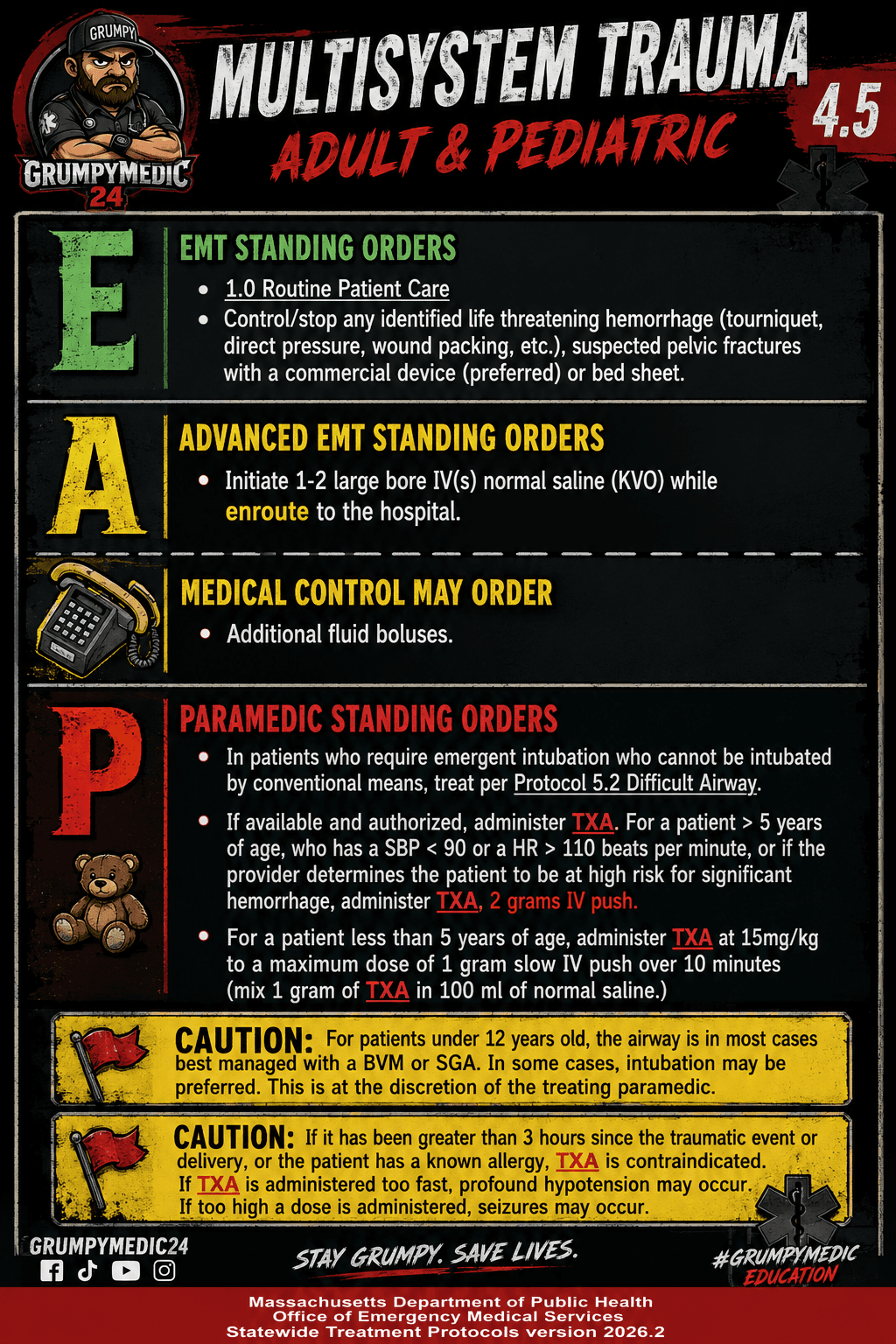
GrumpyMedic multisystem trauma protocol reference

Protocol Reminder

Verify current Massachusetts protocols, addenda, service policy, Medical Control requirements, and scope before clinical use.

Section 03

XABC and Immediate Life Threats

Treat exsanguinating hemorrhage before the traditional ABC sequence.

X — Catastrophic Hemorrhage

  • Expose and identify the bleeding source.
  • Use the fastest effective hemorrhage-control method.
  • Stabilize a suspected pelvic fracture.
  • Reassess after every move.

ABC — Airway, Breathing, Circulation

  • Open and maintain the airway.
  • Support oxygenation and ventilation.
  • Identify chest injury and respiratory failure.
  • Evaluate perfusion and begin rapid transport.

Section 04

Hemorrhage Control

Control life-threatening bleeding immediately.

  • Control or stop identified life-threatening hemorrhage.
  • Use tourniquets for life-threatening extremity bleeding.
  • Apply direct pressure when appropriate.
  • Pack suitable wounds with gauze or a hemostatic dressing.
  • Stabilize suspected pelvic fractures with a commercial device when available or a bed sheet.
  • Reassess all hemorrhage-control interventions after movement and during transport.

Do Not Delay

Vascular access, splinting, or documentation must not delay control of catastrophic hemorrhage.

Section 05

Pelvic Stabilization

A pelvic fracture may conceal major internal hemorrhage.

When to Suspect

  • • High-energy blunt mechanism
  • • Pelvic pain or instability
  • • Pelvic bruising
  • • Unexplained shock

How to Stabilize

Use a commercial pelvic stabilization device when available and appropriate. A bed sheet may be used if necessary.

Section 06

Advanced EMT and Medical Control

Establish access while transport is underway.

Advanced EMT Standing Orders

Initiate one or two large-bore IVs with normal saline at KVO while en route to the hospital.

Medical Control May Order

Additional fluid boluses. Reassess perfusion, respiratory status, and signs of continued hemorrhage.

Section 07

Airway Management

Balance airway intervention against oxygenation, ventilation, and transport time.

Difficult Airway

Patients requiring emergent intubation who cannot be intubated conventionally should be managed under Protocol 5.2 Difficult Airway.

Patients Under 12

The airway is usually best managed with BVM or SGA. Intubation may be preferred in selected cases at the treating paramedic’s discretion.

Section 08

TXA: Patients Older Than 5

Use the adult-style pathway in the supplied protocol.

  • Patient is older than 5 years.
  • SBP is below 90 mm Hg, or heart rate is above 110 beats/minute.
  • The provider determines the patient is at high risk for significant hemorrhage.
  • Administer TXA 2 grams IV push when available and authorized.

Section 09

TXA: Patients Younger Than 5

Use weight-based dosing and slower administration.

  • Patient is younger than 5 years.
  • Administer TXA 15 mg/kg.
  • Maximum dose is 1 gram.
  • Administer slow IV push over 10 minutes.
  • Mix 1 gram of TXA in 100 mL of normal saline.

Dose Example

20 kg × 15 mg/kg = 300 mg TXA

Section 10

TXA Contraindications and Cautions

Timing, allergy, rate, and dose matter.

Caution

Contraindications

Do not administer when more than 3 hours have passed since the traumatic event or delivery, or when the patient has a known TXA allergy.

Caution

Administration Risks

Administration that is too rapid may cause profound hypotension. Excessive dosing may cause seizures.

Section 11

Shock, Transport, and Notification

Definitive hemorrhage control usually occurs at the trauma center.

  • Trend heart rate, blood pressure, mental status, skin, pulses, and capillary refill.
  • Minimize scene time.
  • Continue assessment and vascular access en route.
  • Provide early trauma-center notification.
  • Report mechanism, injuries, interventions, serial vital signs, TXA, and ETA.
  • Follow current destination and Medical Control guidance.

Section 12

Clinical Scenarios

Pause before opening each discussion.

Case: Extremity Hemorrhage

Direct pressure fails to control severe lower-leg bleeding.

Discussion: Apply an appropriate tourniquet, document the time, reassess, and continue rapid transport.
Case: Pelvic Hemorrhage

A struck pedestrian has pelvic pain, instability, and hypotension.

Discussion: Apply a pelvic stabilization device, minimize movement, treat shock, and transport rapidly.
Case: TXA Candidate

An adult has HR 126, SBP 94, abdominal tenderness, and concern for internal hemorrhage.

Discussion: The heart rate exceeds 110 and the provider may determine the patient is at high risk for significant hemorrhage. Follow protocol and authorization requirements.
Case: Pediatric TXA

A 4-year-old weighing 18 kg meets protocol criteria.

Discussion: The dose is 270 mg using 15 mg/kg, administered slowly over 10 minutes, not exceeding 1 gram.
Case: Outside the Window

The patient presents 4 hours after injury.

Discussion: TXA is contraindicated under the supplied protocol because more than 3 hours have passed.

Section 13

Documentation

Document timing, interventions, and response.

  • Mechanism and estimated injury time
  • Primary assessment and life threats
  • Tourniquet site and application time
  • Wound packing and pelvic stabilization
  • Serial vital signs and perfusion
  • Airway and ventilation interventions
  • IV access, fluids, and Medical Control orders
  • TXA indication, dose, route, time, and response
  • Trauma notification, destination, and ETA

Course Review Complete

Ready for the final assessment?

The quiz contains 25 questions. A score of 80% or higher unlocks the certificate.

Begin Quiz