← Back to Courses

Massachusetts EMS Respiratory Course

Bronchospasm / Respiratory Distress

Adult and pediatric respiratory assessment, bronchodilator therapy, epinephrine, noninvasive ventilation, corticosteroids, magnesium, transport priorities, reassessment, and documentation.

Protocols

2.6A & 2.6P

Version

Massachusetts 2026.2

Assessment

25 Questions • 80%

Section 01

Learning Objectives

By the end of this course, the learner should be able to:

Recognize adult and pediatric bronchospasm and respiratory distress.
Assess airway, breathing, work of breathing, lung sounds, oxygenation, and mental status.
Apply EMT, AEMT, and Paramedic standing orders from Massachusetts Protocols 2.6A and 2.6P.
Identify when bronchodilators, epinephrine, CPAP/BiPAP, corticosteroids, and magnesium may be appropriate.
Recognize respiratory fatigue and the need for rapid transport or airway escalation.
Document treatment response and communicate a concise respiratory report.

Section 02

GrumpyMedic Protocol Reference

Review the adult and pediatric quick-reference image before continuing.
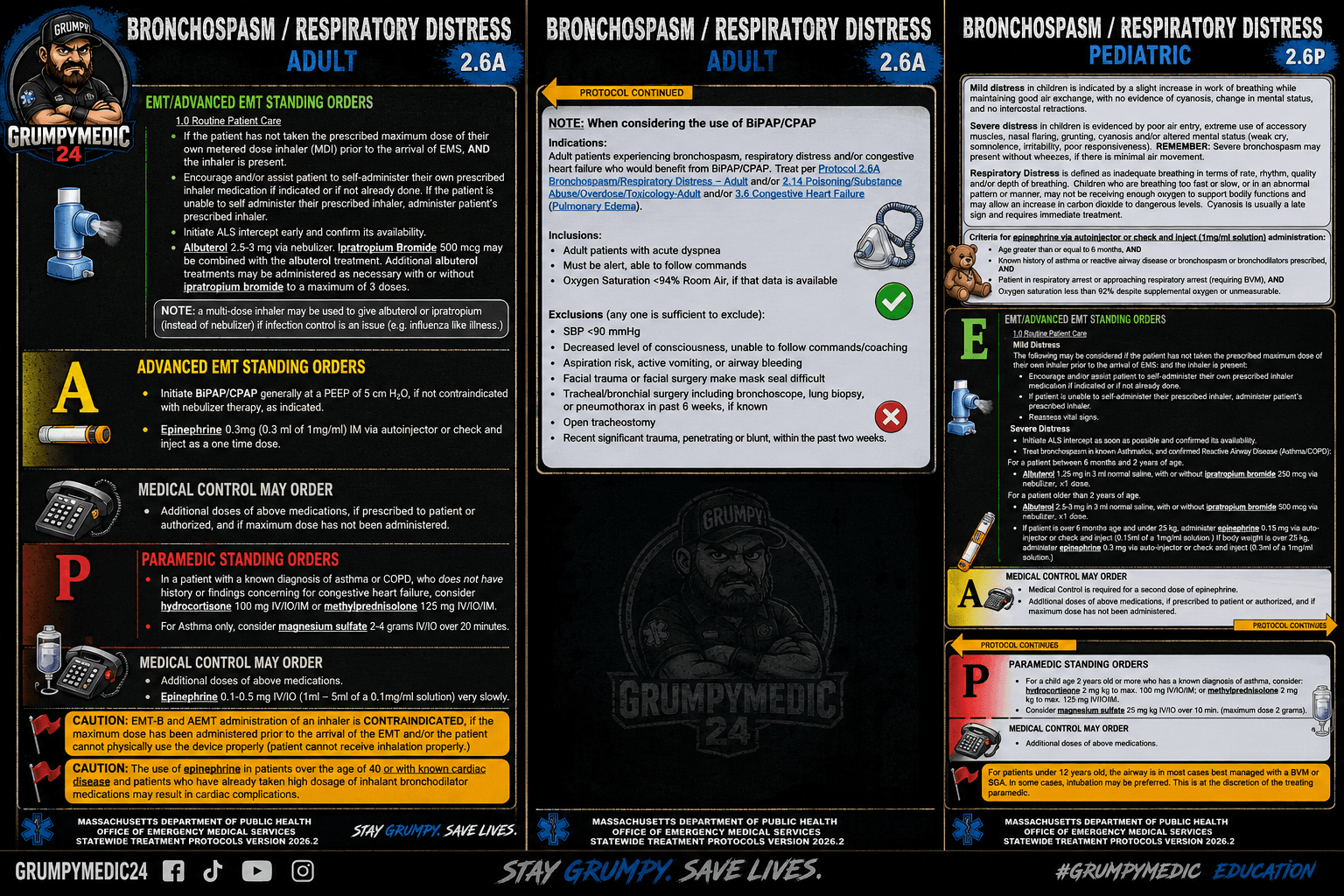
GrumpyMedic adult and pediatric bronchospasm respiratory distress protocol reference

Protocol Reminder

Verify current Massachusetts protocols, addenda, service policy, Medical Control requirements, medication concentrations, and your authorized scope before clinical use.

Section 03

Respiratory Assessment

Severity is determined by the complete clinical picture.

  • Airway patency and ability to speak
  • Respiratory rate, effort, and pattern
  • Accessory-muscle use and retractions
  • Lung sounds and quality of air movement
  • SpO₂ and ETCO₂ when available
  • Skin color and perfusion
  • Mental status and signs of fatigue
  • History of asthma, COPD, medications, and prior intubation

Impending Respiratory Failure

Decreasing air movement, exhaustion, altered mental status, cyanosis, a silent chest, or worsening ventilation despite treatment are high-risk findings.

Section 04

Common Causes

Not all wheezing is asthma.

Bronchospasm

Asthma, COPD, reactive airway disease, and allergic reactions may narrow the lower airways.

Cardiac Causes

Pulmonary edema may produce wheezing. Consider crackles, edema, hypertension, and cardiac history.

Other Causes

Foreign body, infection, toxic exposure, trauma, pneumothorax, and metabolic illness may cause distress.

Section 05

Adult EMT Care

Initial care focuses on oxygenation, bronchodilation, reassessment, and transport.

  • Provide routine patient care and position for comfort.
  • Administer oxygen as clinically indicated.
  • Assist with the patient’s prescribed bronchodilator when allowed.
  • Administer nebulized bronchodilator therapy according to protocol.
  • Add ipratropium when indicated.
  • Reassess breath sounds, work of breathing, SpO₂, and mental status.
  • Request ALS and do not delay transport for worsening distress.

Section 06

Adult AEMT & Paramedic Care

Escalation may include noninvasive ventilation and adjunct medications.

CPAP / BiPAP

Consider for an awake, cooperative patient with adequate airway protection and spontaneous respiratory effort.

Epinephrine

May be indicated in severe bronchospasm or respiratory distress when protocol criteria are met.

Corticosteroids

Hydrocortisone or methylprednisolone may be used according to the current protocol and formulary.

Magnesium Sulfate

May be considered in severe bronchospasm when protocol criteria are met.

Section 07

Noninvasive Ventilation

CPAP or BiPAP can reduce work of breathing in selected patients.

Appropriate Patient

  • Awake and cooperative
  • Able to protect the airway
  • Adequate spontaneous respirations
  • Appropriate blood pressure
  • Effective mask seal
  • No immediate need for intubation

Avoid or Stop When

  • Vomiting or inability to protect the airway
  • Severe altered mental status
  • Respiratory arrest or agonal breathing
  • Hemodynamic instability
  • Facial trauma preventing mask seal
  • Clinical deterioration despite treatment

Section 08

Pediatric Recognition and Care

Children may compensate and then deteriorate quickly.

  • Tachypnea or irregular respirations
  • Nasal flaring and retractions
  • Head bobbing or grunting
  • Wheezing or diminished air movement
  • Difficulty speaking, feeding, or crying
  • Cyanosis or poor perfusion
  • Lethargy, agitation, or exhaustion
  • Bradycardia as a late, ominous sign

Pediatric Caution

A quieter child is not always improving. Decreasing wheezing with worsening effort, poor air movement, or lethargy may indicate fatigue and respiratory failure.

Section 09

Medication Review

Medication choice depends on severity, age, provider level, and current protocol.

Bronchodilators

Albuterol and ipratropium may be used according to current adult and pediatric protocols.

Epinephrine

Confirm patient, indication, concentration, dose, route, and reassessment requirements.

Steroids

Reduce inflammation but do not replace immediate airway and ventilation support.

Magnesium

An adjunct for severe bronchospasm under the appropriate protocol.

Section 10

Clinical Scenarios

Pause before opening each discussion.

Case: Adult Asthma Exacerbation

A 28-year-old has diffuse wheezing, accessory-muscle use, and difficulty speaking in full sentences.

Discussion: Provide oxygen as indicated, begin protocol-directed bronchodilator therapy, reassess frequently, request ALS, and prepare to escalate if air movement or mental status worsens.
Case: Possible Cardiac Wheeze

A 74-year-old has dyspnea, wheezing, crackles, hypertension, and bilateral leg edema.

Discussion: Do not assume asthma. Consider pulmonary edema and apply the appropriate respiratory and cardiac protocol.
Case: Pediatric Fatigue

A child with asthma becomes quieter, less interactive, and has very poor air movement.

Discussion: This may represent respiratory failure rather than improvement. Support ventilation, request ALS, and transport rapidly.
Case: CPAP Failure

An adult on CPAP becomes drowsy and begins vomiting.

Discussion: Remove CPAP, protect the airway, suction as needed, support ventilation, and prepare for advanced airway management.

Section 11

Documentation

Document severity, treatment, and response.

  • Onset, trigger, and respiratory history
  • Initial work of breathing and lung sounds
  • SpO₂ and ETCO₂ when available
  • Medication name, dose, route, and time
  • Noninvasive ventilation settings and tolerance
  • Serial reassessments
  • Adverse effects or deterioration
  • ALS request and Medical Control contact
  • Destination, notification, and ETA

Section 12

Key Takeaways

Review before the final quiz.

Not all wheezing is asthma.
Assess air movement, not just wheezing.
Reassess after every treatment.
A silent chest is an emergency.
Use CPAP/BiPAP only in an appropriate patient.
Children may deteriorate rapidly.
Prepare early for ventilation and airway support.
Do not delay transport for worsening distress.

Course Review Complete

Checking Secure Assessment

Verifying your official Bronchospasm / Respiratory Distress assessment status.