
GrumpyMedic Education
Adult & Pediatric Bradycardia
Massachusetts EMS Protocols 3.3A and 3.3P review covering recognition, routine care, pacing, medication administration, Medical Control options, and key adult-versus-pediatric differences.
Learning Objectives
By the end of this course, the learner should be able to:
Protocols 3.3A and 3.3P Quick Reference
Review the GrumpyMedic protocol image before continuing.
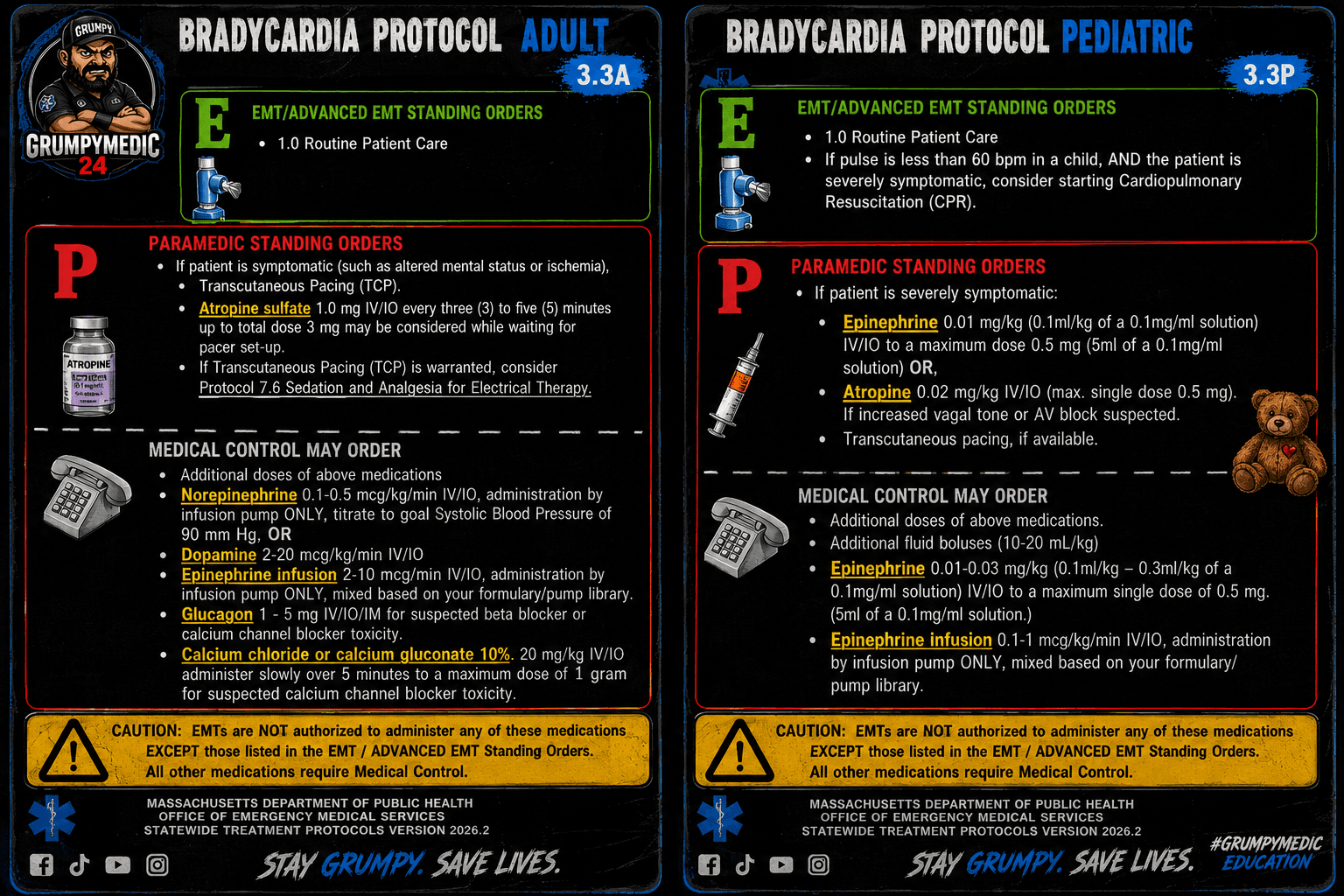
Protocol Reference
This course reviews Massachusetts Statewide Treatment Protocols 3.3A and 3.3P. Providers must follow current statewide protocols, local service policies, Medical Control direction, medication instructions, and their authorized scope of practice.
Recognizing Symptomatic Bradycardia
Treat the patient, not the monitor.
Mental Status
Look for altered mental status, poor responsiveness, or other signs of impaired cerebral perfusion.
Perfusion
Assess blood pressure, skin signs, pulse quality, capillary refill, and evidence of shock.
Ischemia or Instability
Consider chest discomfort, ischemic findings, respiratory compromise, and worsening hemodynamic instability.
Adult Bradycardia — EMT/AEMT
Begin with routine patient care and identify instability early.
Standing Orders
- • Follow Protocol 1.0 Routine Patient Care.
- • Support airway, breathing, circulation, oxygenation, monitoring, and transport as clinically indicated.
- • Request or continue paramedic intercept when the patient is symptomatic or unstable.
Adult Bradycardia — Paramedic
Use pacing and atropine for symptomatic adult bradycardia.
Atropine Sulfate
1.0 mg
IV/IO every 3–5 minutes; maximum total dose 3 mg
Transcutaneous Pacing
TCP
Use for symptomatic bradycardia; consider sedation/analgesia when warranted
Reassessment
Continuous
Monitor perfusion, rhythm, capture, blood pressure, and clinical response
Adult Bradycardia — Medical Control
Additional medications may be ordered when standing-order treatment is insufficient.
- • Additional doses of medications already given.
- • Norepinephrine 0.1–0.5 mcg/kg/min IV/IO by infusion pump, titrated to a systolic blood pressure of 90 mm Hg.
- • Dopamine 2–20 mcg/kg/min IV/IO.
- • Epinephrine infusion 2–10 mcg/min IV/IO by infusion pump.
- • Glucagon 1–5 mg IV/IO/IM for suspected beta-blocker or calcium-channel-blocker toxicity.
- • Calcium chloride or calcium gluconate 10%, 20 mg/kg IV/IO slowly over 5 minutes, maximum 1 gram, for suspected calcium-channel-blocker toxicity.
Pediatric Bradycardia — EMT/AEMT
Pediatric bradycardia is often related to hypoxia or respiratory failure.
- • Follow Protocol 1.0 Routine Patient Care.
- • If the pulse is less than 60 bpm in a child and the patient is severely symptomatic, consider starting CPR.
- • Prioritize oxygenation, ventilation, and correction of reversible causes.
Pediatric Bradycardia — Paramedic
Use weight-based medication dosing and pacing when available.
Epinephrine
0.01 mg/kg
IV/IO; 0.1 mL/kg of 0.1 mg/mL solution; maximum dose 0.5 mg
Atropine
0.02 mg/kg
IV/IO; maximum single dose 0.5 mg when increased vagal tone or AV block is suspected
Transcutaneous Pacing
TCP
Use if available for the severely symptomatic child
Pediatric Bradycardia — Medical Control
Escalation options include additional medication, fluids, and epinephrine infusion.
- • Additional doses of medications already administered.
- • Additional fluid boluses of 10–20 mL/kg.
- • Epinephrine 0.01–0.03 mg/kg IV/IO to a maximum single dose of 0.5 mg.
- • Epinephrine infusion 0.1–1 mcg/kg/min IV/IO by infusion pump.
Adult vs. Pediatric Bradycardia
Keep the major treatment differences clear.
| Topic | Adult | Pediatric |
|---|---|---|
| CPR trigger | Not listed as a bradycardia threshold | Consider CPR when pulse is under 60 bpm and the child is severely symptomatic |
| Primary medication | Atropine 1 mg IV/IO | Epinephrine 0.01 mg/kg IV/IO |
| Atropine role | General symptomatic bradycardia treatment | When increased vagal tone or AV block is suspected |
| Pacing | Standing-order option | Use if available |
Adult Clinical Scenario
Apply Protocol 3.3A to an unstable adult.
Immediate treatment priorities
- • Begin routine patient care and identify symptomatic bradycardia.
- • Prepare for transcutaneous pacing.
- • Administer atropine 1 mg IV/IO every 3–5 minutes to a maximum total dose of 3 mg while pacing is prepared.
- • Consider sedation and analgesia for electrical therapy when warranted.
- • Contact Medical Control for additional treatment if instability continues.
Pediatric Clinical Scenario
Apply Protocol 3.3P to a severely symptomatic child.
Immediate treatment priorities
- • Continue routine patient care with immediate attention to oxygenation and ventilation.
- • Because the pulse is below 60 bpm and the child is severely symptomatic, consider starting CPR.
- • Administer epinephrine 0.01 mg/kg IV/IO to a maximum dose of 0.5 mg.
- • Consider atropine only when increased vagal tone or AV block is suspected.
- • Use transcutaneous pacing if available and appropriate.
Key Takeaways
Review the most important points before taking the quiz.
Final Knowledge Check
Checking Secure Assessment
Verifying your official Adult & Pediatric Bradycardia assessment status.
Educational content only. Follow current Massachusetts statewide protocols, local service policies, Medical Control direction, medication instructions, and your authorized scope of practice.